Put those salad tongs down.
You’re not going to put that mass-market, processed dressing on that salad that you just spent a half-hour prepping from fresh farmer’s market veggies, are you?
If you’re trying to eat less processed food, salad dressing is a great place to start. Despite the fact that they’re often loaded with high-fructose corn syrup and colorings, the top 5 salad dressing brands sell over $1.5B of highly-processed. Most of us, even after spending the time to carefully choose, wash, chop, and prep our organic veggies will glop on some squeeze-bottle dressing to dress up our salads. What’s worse, is that because the mainstream salad dressings are so bland and sugary, we end up using more than we need.
But, if you know the ratios, you can make an endless number of variations without ever consulting a recipe, in five minutes or less. What’s more, when you use good ingredients, the flavors are so intense and delicious, you’ll find yourself using less dressing.
Just remember this ratio for the classic vinaigrette – 1 part vinegar (or lemon) to 3 parts oil (or in chef-speak, 3:1 fat to acid).
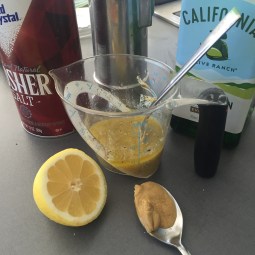 One of my go-to recipes for a weeknight is a kale-caesar salad. The dressing couldn’t be easier – 1 oz of fresh lemon juice, 3 oz of extra-virgin olive oil, a teaspoon of good quality dijon mustard (which helps emulsify the dressing and rounds out the flavor), salt, pepper, and a clove of garlic. Whisk. Enjoy.
Once you know the ratio, you’re only limited by your creativity. Balsamic vinaigrette? 1 oz balsamic vinegar, 3 oz extra virgin olive oil, half a minced shallot, salt, pepper, and a teaspoon of dijon. Whisk.
What about a creamy dressing? Use a little less oil, say 2 oz of olive oil, with 1 oz of lemon juice,and add 1/2 cup of greek yogurt. Toss in some fresh parsley and fresh basil, salt, pepper, and blend. Bob’s your Uncle.
Like anything, the vinaigrette ratio is a guideline. You may need a bit more oil if you have particularly sharp and acidic lemons, or a little less if you’re using a mild vinegar. Experiment, and as always when you’re cooking – taste, then taste again.
Finally, a couple pro-tips (not that I’m a pro, nor have I played one on TV, but I read and listen to the pros) – treat yourself to a good extra-virgin olive oil (EVOO). Most of the stuff at the grocery store is fake, or at least heavily blended with other oils. It’s scandalous. Look for EVOO with a harvest date, and buy locally if you can. California is making some incredible olive oils. Rule of thumb – if it’s less than $8-$10/liter, it’s probably fake. There’s no way you can buy real olive oil from Spain or Italy, package it, and import it for less. Same goes for Dijon mustard, which is a great emulsifier and adds wonderful flavor to dressings, just don’t get the mass-market, sad-excuse for Dijon, Dijon. Splurge a little and get a Dijon that’s actually made in France. You’ll only go through a jar a month or two, so live a little.
Stay tuned. Next time we’ll tackle the other factory-produced food staple – breakfast cereals.
 Put that recipe down